

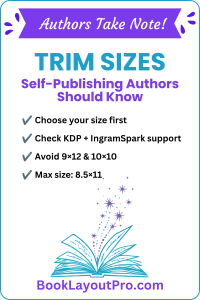
 Choosing the right trim size is one of the most important decisions you’ll make when preparing a book for publication. It affects printing cost, reader expectations, layout design, and distribution options. And if you choose a trim size that isn’t supported by your printer — especially Amazon KDP or IngramSpark — you may find yourself reformatting an entire book at the last minute.
This guide walks you through how to choose the right trim size and how to avoid the most common mistakes authors make.
What Is Trim Size?
Trim size is the final width × height of your printed book. For example, 6″ × 9″ is a standard trade paperback size.
Trim size determines:
- How many words fit on a page
- Total page count
- Printing cost
- How your book compares visually to others in its genre
Paperback vs. Hardcover: Why Trim Size Matters Even More
Many authors assume that if a trim size works for paperback, it will work for hardcover — but that’s not true.
Both Amazon KDP and IngramSpark support paperback trim sizes up to 8.5×11. Anything larger — such as 9×12 or 10×10 — is not supported by either platform.
Hardcover trim sizes are also limited. KDP supports a small set of sizes up to 8.5×11 (see chart below). IngramSpark supports a wider range of bindings, but still does not exceed 8.5×11 (check out their trim size matrix).
If you want a trim size larger than 8.5×11, you’ll need a specialty printer.
What Amazon KDP Supports
Amazon KDP offers a fixed list of trim sizes:
| Trim Size | Paperback | Hardcover |
|---|---|---|
| 5″ × 8″ | ✔️ | ❌ |
| 5.25″ × 8″ | ✔️ | ❌ |
| 5.5″ × 8.5″ | ✔️ | ✔️ |
| 6″ × 9″ | ✔️ | ✔️ |
| 6.14″ × 9.21″ | ✔️ | ✔️ |
| 6.69″ × 9.61″ | ✔️ | ❌ |
| 7″ × 10″ | ✔️ | ✔️ |
| 7.44″ × 9.69″ | ✔️ | ❌ |
| 7.5″ × 9.25″ | ✔️ | ❌ |
| 8″ × 10″ | ✔️ | ❌ |
| 8.25″ × 6″ | ✔️ | ❌ |
| 8.25″ × 8.25″ | ✔️ | ❌ |
| 8.25″ × 11″ | ❌ | ✔️ |
| 8.5″ × 11″ | ✔️ | ❌ |
| 8.5″ × 8.5″ | ✔️ | ❌ |
| 8.27″ × 11.69″ | ✔️ | ❌ |
These sizes cover most fiction, nonfiction, workbooks, and square children’s books.
What IngramSpark Supports
IngramSpark supports a range of trim sizes depending on paper type, color vs. black & white, and binding type. Their supported sizes run from 4×6 up to 8.5×11. Because their options vary by configuration, I recommend checking their official trim‑size matrix: IngramSpark Trim Size Matrix (PDF) or search “IngramSpark trim size matrix” to find the most current version. [Please note: Perfectbound = paperback, Case Laminate = hardcover.]
Some Trim Sizes That Cause Trouble
9×12 — Not supported by KDP or IngramSpark: This size is common in traditionally printed children’s books, but neither KDP nor IngramSpark supports it.
I’ve seen authors format an entire book at 9×12 only to discover they must resize everything to 8.5×11 to publish on both platforms.
10×10 — Not supported by KDP or IngramSpark: This is another popular children’s book size — but again, neither platform supports it. If you want 10×10, you’ll need a specialty printer.
If you want a size not supported by KDP or IngramSpark, you’ll need to find an offset printer, a digital short-run printer, or—if it is a children’s book—a specialty manufacturer. Generally, these printers can produce custom sizes, but expect higher upfront costs, minimum order quantities, and more complex planning to get your books into stores or on websites.
For most self‑publishers, sticking with KDP + IngramSpark sizes is the most practical path.
Always Verify Trim Sizes Before You Begin
Before you start formatting your book, visit:
Supported sizes can change, and verifying early can save hours of redesign work.
Genre Standards
These are traditional publishing norms — but always confirm that your printer supports your chosen size.
Fiction
- 5″ × 8″
- 5.25″ × 8″
- 5.5″ × 8.5″
- 6″ × 9″
Nonfiction
- 6″ × 9″
- 7″ × 10″
- 8.5″ × 11″
Memoir
- 5.5″ × 8.5″
- 6″ × 9″
Children’s Books
- 8″ × 10″
- 8.5″ × 8.5″
- Larger sizes (9×12, 10×10) → not supported by KDP or IngramSpark
Poetry
- 5″ × 8″
- 6″ × 9″
Final Thoughts
Choosing the right trim size is a blend of genre expectations, reader experience, printing cost, and distribution strategy. And, as many authors have discovered the hard way, choosing a size that isn’t supported by your printer can mean redoing hours of layout work.
When in doubt, choose a trim size supported by both KDP and IngramSpark — especially if you want both paperback and hardcover.
Do you want to avoid issues with your book’s cover? Read our article, Cover Templates Demystified: What Authors Really Need to Know.
A note about AI: AI tools assisted in developing this article. The ideas, recommendations, and final editorial decisions are my own.